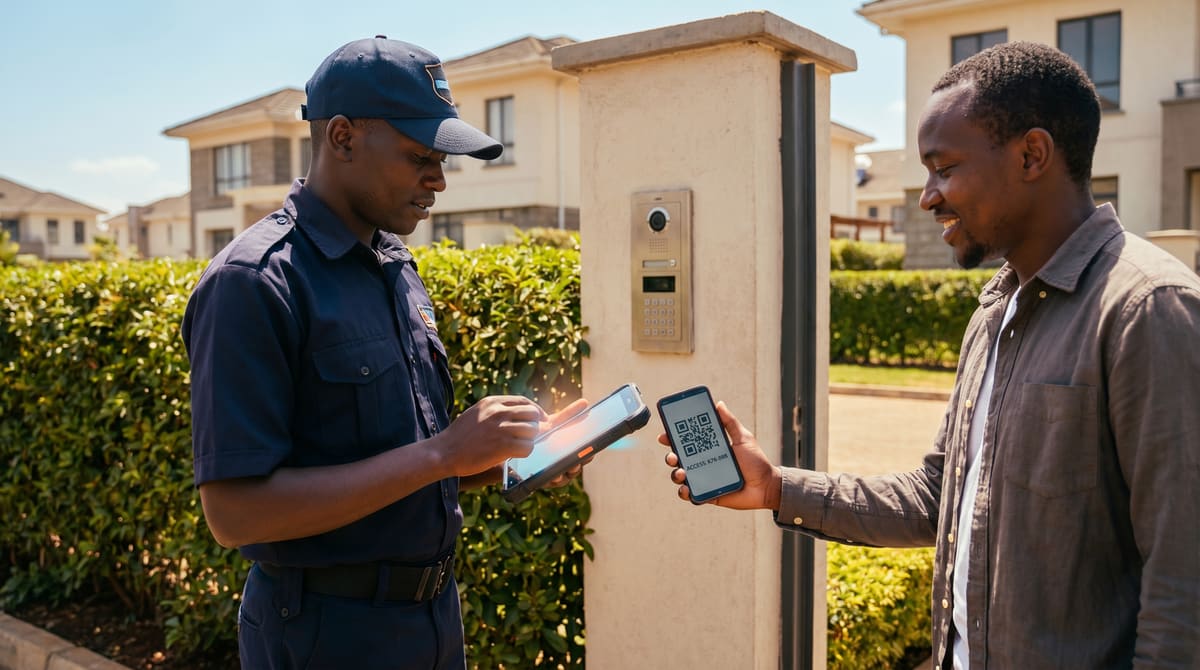
Gate access control · Kenya
An audit trail with a gate attached.
Most purchasing decisions for estate security software begin with the wrong question. What Kenyan properties actually need is an audit trail with a gate attached.
Most purchasing decisions for estate security software begin with the wrong question. The question is usually "which system is cheapest?" or "does it integrate with our intercom?" These are real questions, but they follow from an assumption that has not been examined: that what you need is access control software. What most Kenyan estates actually need is an audit trail with a gate attached.
The security technology market in Kenya operates across three overlapping product categories that are often presented as equivalent: access control (who can enter), visitor management (who is entering now), and security operations software (what the guard is doing and when). These are related but distinct. A biometric turnstile solves access control. A WhatsApp group solves visitor management — badly. A spreadsheet on the committee chair's laptop solves security operations — also badly.
The failure mode of buying access control when you need visitor management — or vice versa — is that you end up with hardware that works and records that don't, or records that exist and gates that remain open anyway. The category error is common because vendors rarely distinguish between them.
An estate gate has three jobs. First, it needs to let in people who should be let in, without making the experience difficult enough that residents route around it. Second, it needs to create a record of every entry and exit that is timestamped, attributed to a named guard or resident approval, and not editable after the fact. Third, it needs to surface exceptions — walk-up visitors outside normal hours, vehicles without pre-registration, access attempts at unusual times — to the person who needs to act on them.
Most access control systems sold to Kenyan estates do the first job adequately and fail at the second and third.
A practical truth about estate security: the gate holds only as much authority as residents give it. If the pre-approval process is difficult — requires a phone call, a WhatsApp message to an individual guard, or physical presence at the management office — residents will find informal channels. They will call the guard directly. They will walk their guest in. They will leave a note at the gatehouse.
Each of these workarounds is understandable. Each one is an unrecorded entry.
The measure of a gate system's real-world effectiveness is not its technical capability but its resident adoption rate. A system that generates pre-approved arrivals for 80% of visitors produces a meaningful audit trail. A system that residents bypass 60% of the time produces a legal liability dressed up as security infrastructure.
Four questions that any reputable vendor should be able to answer without hesitation:
Can you show me the audit log format — what is captured, what can be edited after the fact, and how long it is retained? A log that can be amended is not a log. A log retained for 30 days fails the Kenya Data Protection Act.
Does the system work offline? Power cuts and connectivity failures in Nairobi are not edge cases. A gate that stops working when the router is down is not a gate — it is a barrier that fails in the conditions most likely to matter.
What happens to the data when we leave? Your property's visitor history belongs to the property. Export should be standard, not a negotiation, and should be available at any time — not only at contract termination.
Who bears the DPA obligation — you or the vendor? Under Kenyan law, the property committee is the data controller. The vendor is a data processor operating under your instructions. If a vendor has not heard of a Data Processing Agreement, that answers your question about their compliance posture.
The gate is not the hard part. The record is the hard part. A committee that can answer, with precision, who visited the property on any given day in the past seven years — and demonstrate that the data behind that answer was handled lawfully — has built something durable. A committee that has installed a barrier is still operating on trust.
Long-form essays on operating African property. No marketing emails, no product announcements — just the ideas.